Botswana safari guide with top destinations and 10 must‑do experiences including mokoro rides, river cruises, predator sightings, salt pans, and wild dog hunts
Planning a Botswana safari means choosing experiences that highlight the country’s extraordinary diversity of landscapes and wildlife. From the waterways of the Okavango Delta to the vast salt pans of Makgadikgadi, each destination offers something distinct and memorable. A mokoro canoe ride brings you close to elephants and hippos in silence, while Chobe River cruises showcase Africa’s largest elephant herds at sunset. Predator sightings in Moremi and wild dog hunts in Linyanti add intensity, while walking with meerkats or sleeping under the stars on the pans creates rare, personal moments. The zebra migration across Nxai Pan, rhino tracking at Khama Sanctuary, and helicopter flights over the Delta expand the safari beyond traditional game drives. Timing your visit with the dry or wet seasons shapes what you see, but every option delivers unique value. A well-planned Botswana safari blends water, land, and desert experiences into one of Africa’s most rewarding adventures
Best Botswana safari experiences
3 Days Best of Botswana Safari in Moremi Game Reserve
3 Days Botswana Safari in Chobe National Park from Victoria Falls
3 Days classic Chobe family safari packages
4 Day Botswana Safari with Makgadikgadi Zebra Migration Experience
4 Days Botswana Tour Combo with Chobe Safari and Victoria Falls
5 Days Botswana Tour in Okavango Delta and Moremi Game Reserve
5 Days Botswana Wildlife Safari
6 Days Botswana Family Safari in the Okavango Delta & Makgadikgadi NP
7 Days Makgadikgadi Pans, Okavango Delta, and Chobe Botswana Safari
What are top Botswana safari destinations?
Top Botswana safari destinations include the Okavango Delta, Chobe National Park, Moremi Game Reserve, the Makgadikgadi Salt Pans, and the Central Kalahari Game Reserve. The Okavango Delta is the world's largest inland delta, a UNESCO site where you glide through waterways by mokoro canoe to see elephants, hippos, and over 500 bird species . Chobe National Park holds Africa's largest elephant population, offering river cruises where you watch herds drink at sunset . Moremi Game Reserve, the oldest protected area of the Delta, is known for dense predator sightings including lions, leopards, and wild dogs, plus rhino tracking . The Makgadikgadi Pans are ancient salt flats where you quad bike across white landscapes, sleep under stars, and walk with habituated meerkats . The Central Kalahari Game Reserve is Africa's second-largest reserve, home to desert-adapted black-maned lions and the San Bushmen . Each destination works best at different times of year
The Best 10 safari experiences not to miss on Botswana safari
1. Glide through the Okavango Delta in a mokoro canoe
A Botswana safari in the Okavango Delta is incomplete without a mokoro ride. This traditional dugout canoe, now made from fibreglass, takes you through narrow channels lined with water lilies and reeds. You sit inches above clear water, watching elephants drink on islands and hippos wade nearby. The poler guides have navigated these waters since childhood and know every hidden lagoon. This silent water Botswana safari lets you approach animals without engine noise, including red lechwe antelope and fish eagles. Unlike vehicle-based safaris, the mokoro gives you a slow, close view of frogs, dragonflies, and aquatic birds. It is the most unique water safari in Africa and a true highlight of any visit.

2. Watch huge elephant herds on a Chobe River cruise
Chobe National Park holds Africa's largest elephant population, and a river cruise is the best way to see them on your Botswana safari. You sit at water level as elephant herds of fifty or more cross the river or drink from the banks. Hippos surface nearby, crocodiles slide off sandbars, and buffalo wade through shallows. The afternoon cruise, when animals come to drink, gives you close-up views impossible from a vehicle. Many Botswana safari packages combine a morning game drive with an afternoon boat trip, giving you two different perspectives of the same park. Birds like fish eagles, ibises, and kingfishers are everywhere along the river, adding to the experience.

3. See lions hunt in the open grasslands of Moremi
Moremi Game Reserve sits within the Okavango Delta and offers some of the best predator viewing on any Botswana safari. Large lion prides roam the floodplains and dry islands, making sightings common. You watch lions stalk lechwe, zebra, and buffalo across open terrain where the grass stays short. Unlike forested parks, Moremi's mix of water and dry land means you see predators from a distance before they move in. A Botswana safari here also includes leopards, cheetahs, and spotted hyenas, though wild dogs are rarer. Early morning drives give you the best chance to see a hunt in progress. Moremi is less crowded than Chobe, so you share sightings with only a few other vehicles.
4. Walk among meerkats on the Makgadikgadi salt pans

The Makgadikgadi Pans are a vast, white landscape of ancient salt flats, offering an unusual Botswana safari experience. Here, habituated meerkat colonies let you sit on the ground as they climb on your lap and shoulders. These small, curious creatures stand on their hind legs to scan for predators, then go back to digging for insects. Your Botswana safari can also include quad biking across the cracked salt surface, a surreal experience like driving on another planet. At night, with zero light pollution, the stars fill the entire sky. You can camp directly on the pan, sleeping under a blanket of stars with no tents or walls around you. This is a purely unique activity found nowhere else.
5. Watch African wild dogs hunt in the Linyanti or Okavango

African wild dogs are among Africa's most endangered predators, and a Botswana safari gives you one of the best chances to see them. The Linyanti Reserve and parts of the Okavango Delta have healthy packs that hunt during daylight hours. You watch the pack coordinate a chase, flanking impalas or zebras with incredible teamwork. Unlike lions, wild dogs hunt during cooler morning hours, so sightings happen when you are already on drive. A recent Botswana safari report described a pack of twelve adults and ten pups feasting on a kill, with pups play-fighting while adults kept watch. Wild dogs are rare, so seeing them is a special event even for experienced safari-goers. Book a camp in Linyanti for the best odds.
6. See the zebra migration on the Makgadikgadi and Nxai Pans
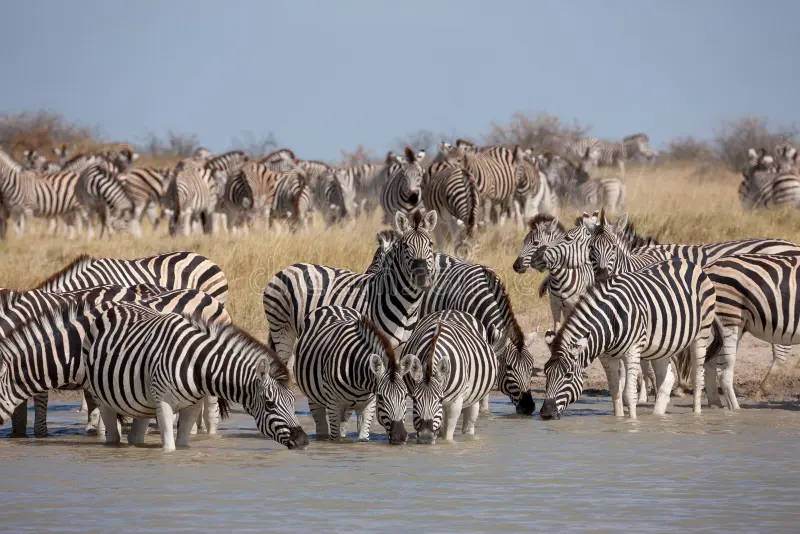
Botswana has Africa's second-largest zebra migration, and a Botswana safari timed right will show you thousands of animals on the move. The migration peaks during the wet season from November to March, when the pans turn green with fresh grass. Herds of zebra, springbok, and gemsbok gather at waterholes, drawing lions and cheetahs that follow the prey. The open landscape on a Botswana safari here means you see animals spread across the horizon, not hidden in bushes. Nxai Pan National Park is a key viewing spot, with Baines' Baobabs standing as ancient landmarks over 1,000 years old. This migration is less famous than the Serengeti but far less crowded and just as dramatic.
7. Photograph Baines' Baobabs at sunrise or sunset
In Nxai Pan National Park, seven giant baobab trees stand on the edge of a salt pan, offering a landscape stop on your Botswana safari. These trees are over 1,000 years old and reach twenty metres tall, with massive trunks and twisted branches. The best time to visit during your Botswana safari is sunrise or sunset, when the low sun turns the trees golden and the pan reflects the sky. During the wet season, the pan fills with shallow water, creating mirror reflections that double the trees in your photos. The area has no fences or crowds, so you sit alone with these ancient giants. It is a purely landscape-focused experience, different from animal viewing but equally powerful for photographers.
8. Spend a night on the Makgadikgadi salt pan under open sky
Sleeping directly on the salt pan is a Botswana safari specialty that you cannot find in other African countries. You drive onto the white crust, set up beds with no tents, and lie down under a sky with no light pollution. The Milky Way stretches from horizon to horizon, and shooting stars appear every few minutes. Your Botswana safari guides set up a campfire and cook dinner while you watch the sun set over flat white nothingness. You hear no vehicles, no generators, no other people. Only wind and silence. This works best during the dry season from May to October, when the pan surface is hard and the nights are cool. Bring warm clothes because desert temperatures drop fast after sunset.
9. Track rhinos on foot at the Khama Rhino Sanctuary

The Khama Rhino Sanctuary is a conservation success story and a valuable stop on any Botswana safari focused on rare animals. You join armed rangers on foot to track white and black rhinos through bushveld, learning to read footprints and dung. This walking Botswana safari is safe because rangers keep distance and watch the rhinos' behaviour. Seeing a white rhino from ground level, not from a vehicle, gives you a real sense of its massive size. The sanctuary also has giraffes, zebras, and antelopes, but rhinos are the main draw. It sits near Serowe, about three hours from Maun, making it an easy addition to a longer Botswana route. Entry fees directly support anti-poaching efforts.
10. Take a helicopter flight over the Okavango Delta
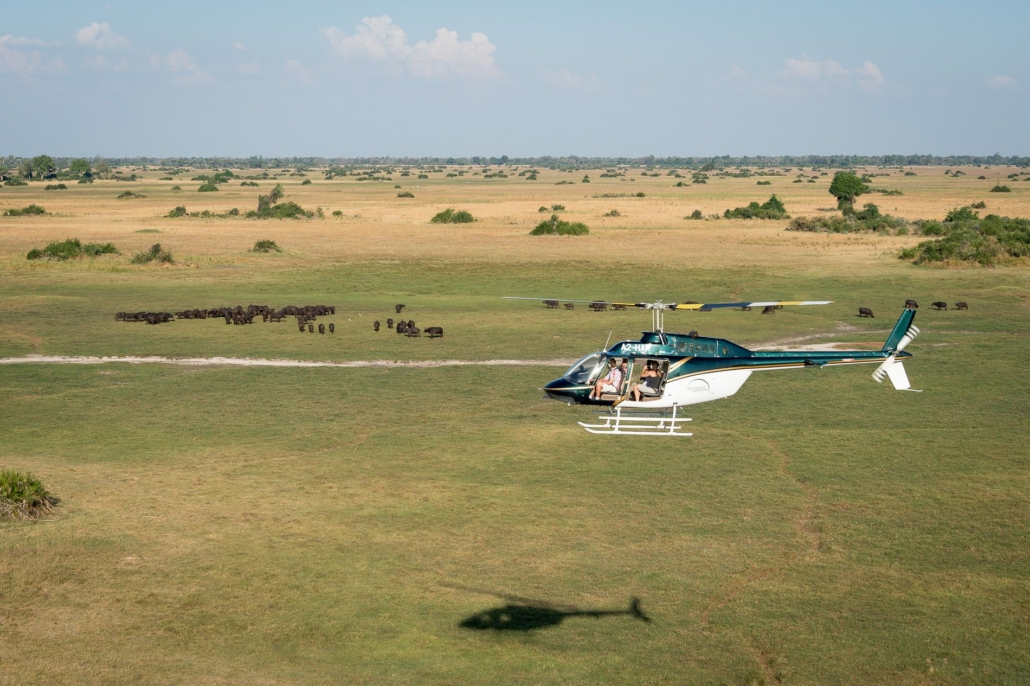
A helicopter flight gives you the only view that shows the Delta's full scale, making it a top addition to any Botswana safari. From the air, you see thousands of blue channels, green islands, and floodplains spreading into the Kalahari sand. Pilots fly low enough to spot elephants, hippos, and buffalo from above, showing you how water carves this fan-shaped wetland. A Botswana safari with a helicopter flight lasts twenty to forty-five minutes, and you book it from camps inside the Delta or from Maun town. It is expensive, usually $300 to $600 per person, but it shows you a landscape you cannot understand from ground level. Many travelers call this the highlight of their entire trip
Best time to go and experience Botswana safari
The best time for a Botswana safari is the dry winter months from May to October. During this period, rain stops completely, and vegetation thins out, making animals visible from further distances. Wildlife gathers around permanent water sources like the Okavando Delta channels and the Chobe River, so you see elephants, buffalo, and predators in high concentrations. September and October are particularly good for predator action because temperatures rise and animals stay near shrinking waterholes. A Botswana safari in these months also offers cooler mornings and evenings, though midday can reach 30°C to 35°C. The downside is higher prices and more vehicles in popular areas like Chobe and Moremi. Book your camps six months ahead for June to October travel.
The wet season from November to March works for specific experiences on a Botswana safari. This is the best time for bird watching because migratory species arrive and resident birds display breeding plumage. The zebra migration peaks on the Makgadikgadi and Nxai Pans between December and February, with thousands of animals on open grasslands. Green season Botswana safari packages cost nearly half the dry season rates, and you have camps almost to yourself. However, some roads become muddy and inaccessible, especially in the Delta. April and May offer a transition period with drying trails, lower prices, and good wildlife viewing before peak season starts.
How much does a Botswana safari
A Botswana safari cost varies significantly based on your travel style and season. For budget travelers, mobile camping safaris range from $195 to $550 per person per night, with longer tours like a 12-day trip costing approximately $3,000 plus a $300 local park fee paid on arrival. Mid-range safaris in comfortable lodges or permanent tented camps typically cost $320 to $1,100 per night and include meals and guided game drives . Luxury and fly-in safaris, which offer private concessions, all-inclusive services, and internal light aircraft transfers, start at $1,000 and can exceed $4,000 per person per night . Peak season from July to October commands the highest prices, while the green season from December to March can offer savings of 40% to 60%
How to get there for Botswana safari
The quickest and most common way to reach a Botswana safari is by flying into the country's main international gateway, Sir Seretse Khama International Airport (GBE) in Gaborone, which has multiple daily nonstop flights from Johannesburg (45-60 minutes) on carriers like Air Botswana, Airlink, and South African Airways . From Gaborone, you then take a connecting domestic flight to Maun (about 1.5 hours) or Kasane (also about 1.5 hours), the two main safari hubs . For travelers heading directly to safari areas, Maun Airport (MUB) and Kasane Airport (BBK) also receive direct international flights from Johannesburg and Cape Town, saving you a connection through Gaborone . Once inside Botswana, light aircraft charters operated by companies like Mack Air connect you to remote airstrips across the Okavango Delta, Moremi, and Linyanti regions, with access to over 70 airstrips throughout the country. Most fly-in safari packages include these light aircraft flights between camps.
Alternatively, you can drive into Botswana from neighboring countries. Botswana is accessible by road from South Africa, Namibia, Zimbabwe, and Zambia through several border posts. The most common self-drive route starts in Johannesburg, South Africa, where you rent a 4x4 vehicle and drive north through the Groblersbrug/Martins Drift border crossing into Botswana . Kasane, located at the junction of four countries (Botswana, Namibia, Zambia, and Zimbabwe), serves as an excellent starting point for self-drive safaris, with supermarkets, gas stations, and an international airport for those who want to fly in and drive out. If driving, you will need a certified copy of the vehicle registration, a cross-border permit, a valid driver's license (an International Driving Permit is recommended), and third-party insurance available at the border. The self-drive option gives you independence and flexibility, with a good quality road network connecting major points of interest, though remote reserves require a proper 4x4 vehicle
Best tips for Experiencing Botswana safari
The best tips for experiencing a Botswana safari focus on planning, packing, and respecting the environment. Book your safari 9 to 12 months ahead for peak season from June to October because Botswana's top camps in the Okavango Delta and Linyanti have very limited bed numbers and fill early. Pack neutral-colored clothing in khaki, brown, and olive to blend into the bush, and avoid white and black which attract tsetse flies. Bring a good pair of binoculars because many animals stay far from the tracks in this low-density, high-cost destination where seeing quality matters more than quantity. For the best predator viewing, focus your Botswana safari on Moremi Game Reserve and the Linyanti region where wild dogs, lions, and leopards are consistently seen. Budget for internal light aircraft flights if visiting the Delta, as these are often mandatory and can cost $500 to $1,000 per person. Finally, hire a local guide rather than self-driving in the Delta or Linyanti because deep sand and water crossings require expert navigation and recovery gear
Top lodges to stay in During Botswana safari
For a Botswana safari, top lodges include Mombo Camp in the Okavango Delta, often called the "Place of Plenty" and widely regarded as one of Africa's finest safari camps for exceptional predator sightings on Chief's Island. In the same region, Tubu Tree Camp on Hunda Island offers elevated tree-house style tents and is renowned for its reliable leopard sightings, particularly during flood season from June to September. On the Chobe Riverfront, Chobe Game Lodge is the only lodge located inside Chobe National Park, providing direct access to massive elephant herds and river cruises from its prime position. For the Linyanti area, DumaTau Camp sits between two elephant corridors, offering sweeping lagoon views and night drives in a private reserve that borders Chobe. Each lodge provides expert guiding, and booking well in advance is essential, especially for peak season travel from June to October.
Booking Botswana safari with Dav safaris
Booking a Botswana safari with Dav Safaris is a direct process through our website at www.davsafaris.com or by contacting their team via email at info@davsafaris.com and phone at +256-757-795-781 . The company specializes in crafting tailored itineraries to suit your budget, travel style, and interests, offering expert-guided tours across Botswana's premier destinations including the Okavango Delta, Chobe National Park, and the Makgadikgadi Pans . It is highly recommended to book your Botswana safari well in advance, especially for peak season travel from June to October, as demand for camps and lodges in this pristine, low-density destination is consistently high . Dav Safaris handles all logistical details, including accommodations, internal light aircraft transfers to remote airstrips, and game drives, allowing you to focus fully on your safari experience . Recent traveler reviews praise the company for its exceptional service, knowledgeable guides, and seamless trip organization . Contact Dav Safaris directly to request a custom quote and begin planning your Botswana safari today